operation 'legacy'

  The Friends Of The Suffolk Regiment
  • Introduction
  • History
    • Our Regimental 'Family'
  • Publications
  • Archives
    • Operation 'Legacy'
    • Friends News Archives
    • Battlefield Tours
  • Join Us
  • Friends News
  • Contact

The Epitome Of The Fighting Suffolk Soldier

4/10/2015

 
Picture

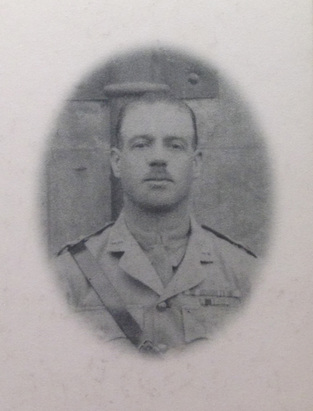
On the night of the 2/3rd October 1915 in the ill-fated attack on the Hohenzollern Redoubt by the 1st Battalion, Corporal Nathaniel Bott   would reach the enemy parapet with some of the men from his section.
​Bott's officer and Sergeant had been wounded in the initial advance, forcing Bott to assume command of the section. Urging his men forward he succeeded in getting his men to the old enemy front line.
Whilst here, he organised the defence to revert the trenches into a stronghold. During this action he was wounded in nine separate places, and was extremely weak from loss of blood. Despite this, he insisted on being propped up on the German parapet to allow him to continue to give commands to his men.
As the attack faltered and the Battalion fell back, Bott was conveyed from the battlefield on the back of another man. When he recovered from his wounds in hospital, he was informed that he had been awarded the Distinguished Conduct Medal (DCM) for his actions that day.
​Bott would later be promoted to Sergeant and would be awarded the Military Medal in 1917 and granted a commission. Promoted Lieutenant in 1919, he would be gazetted with the MC following the armistice. He would remain as a Lieutenant for the the rest of his Army career before leaving the 1st Battalion in 1928. ​It was said upon his retirement from the Regiment, that if ever a single act of gallantry epitomized the fighting Suffolk soldier during the Great War, it was Bott's award of the DCM.

Complete Failure

3/10/2015

 
Picture
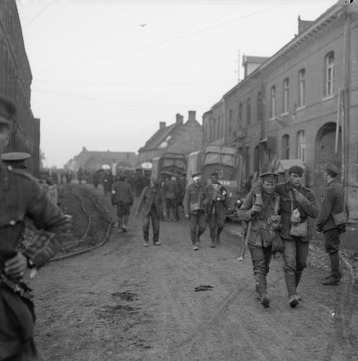
At midnight on the 3rd October 1915, Major Sinclair-Johnson got the men out of the trenches and into two lines. C and D Company’s were to go first, with A and B Company’s following behind. As the whistles blew, A Company got out and charged off ahead into the darkness.
C Company followed behind but could not catch up with them. Though the land over which they were attaching was relatively flat and the moon was full, the smoke from the artillery fire seemed to make the men disappear. D Company on C Company's right could not be found. They had either never gone over the top or had veered massively off course to the south east. In desperation, Sinclair-Johnson called forward B Company to fill in their gap but as they advanced, they too veered to the right. The attack was failing dramatically and spectacularly.
The advance, which has now descended into chaos with the CO unable to see where his men were. No communication existed between the Company's and their was no sense of consolidation to rally the men together and press on. Groups of 2 and 3 men sheltered here and there in shell holes or lying flat in the open, afraid to go on. Remarkably, the section commanders had no real intelligence as to their objective or direction except to "head for a permanently displayed red lamp on the enemy's parapet." When this was promptly extinguished by the Germans, all sense of direction vanished. The moon, which had moved considerably since the attack commenced, caused the attackers to advance wildly off course.
As the German machine guns fired randomly into the darkness, the losses mounted. 7 officers were wounded along 150 other ranks. Many more had been killed, but some had not even taken part in the assault. The remnants of those who remained were ordered to retire by bugle call and made the way back to the British lines at around 1.15am. A second attack was ordered for 4.30am, but it was subsequently cancelled.
​It was a day of abysmal failures. Poor communications, clogged trenches, inefficient command and a total lack of artillery support, led to the failure of the attack that night. Intelligence was key to future attacks, but for all these faults, gallantry was displayed that night.


Chaos Before The Dreaded Hohenzollern

2/10/2015

 
Picture
The days of the 2nd/3rd October were not ones of success for the 1st Battalion at Loss - unlike those of their counterparts in the 9th Battalion just a few days before.
The Battalion, which had been in the Ypres Salient until three weeks before, were still going through a process of rebuilding following their
costly battles at Frezenberg and Bellewarde in May but, with the failure of the British offensive at Loos, they were rushed hurriedly into this sector and almost immediately pushed into a desperate attack again a heavily fortified German position named the "Hohenzollern Redoubt."
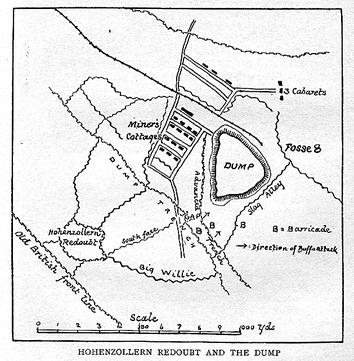
On the morning of the 1st October, an order was received to proceed to the front line support trenches in front of the ‘Hohenzollern Redoubt’ to cover an attack being made by 1st Welsh and 2nd Cheshires. This defensive ‘redoubt’ was made up of a series of trenches around an old coal pit, known as ‘Fosse 8’ with the two western trenches being affectionately known as ‘Little Willie’ and ‘Big Willie.’ Attacks were made by each unit of the 28th Division in turn, all meeting with little or no success. Soon the Battalion knew, it would be their turn.
On that afternoon, Lieutenant Parsons and Owen, took 70 men from B Company to the area in front of ‘Big Willie’ trench to support an attack by the Northumberland Fusiliers. At around 10.00am, Battalion Headquarters, complete with the CO; Lieutenant-Colonel White, arrived with A Company in an complex of British trenches known as the ‘Central Keep’ C and D Company’s remained in support trenches to the rear, whilst B company moved up
to support A Company.
They were however not called to advance that afternoon following the Fusiliers unsuccessful attack that morning and shortly after lunch, Major Sinclair- Wilson went to the dugout that housed Battalion headquarters where he received his orders to attack ‘Little
Willie’ trench that evening at 8.30pm.
The 1st Welsh who had attacked earlier that day had been driven out and it was now decided that 1st Suffolk would attack again at sunset. The time was chose so that reinforcements and supplies could be brought up as quick as possible in the darkness that followed. Wishing to find out what confronted them. The C.O and 2IC went down the line to a sap, where they could crawl forward and view the trench through their binoculars. Satisfied that they knew the lay of the land, they returned from their reconnaissance at about 4.30pm.

Back at Battalion HQ, the orderly clerk wrote out the Operational Orders complete with very basic sketch maps for distribution to each of the four Company commanders. Within half an hour, they were ready and the orders were issued shortly after 5.00pm.
As the attacking Company’s moved up for their rear line positions, they came upon
trenches clogged with the dead and wounded of the morning’s attack. Despite their best efforts, the men, carrying picks, shovels and bombs in boxes, just couldn’t get through the jam. Progress was so slow that by 7.30pm, none of the attacking Company’s were even in the front line. Some were still stuck in clogged communication trenches many yards behind the line. One Company Commander sent word back by a hand written message in a chain from man to man to ask that in view of this chaos, whether the attack could be postponed for two hours (it would now commence at 10.30pm) so as to give him time to get up to the front line. His request was granted.
​But as
darkness descended, the chaos got worse as men bumped into one another in an effort to keep moving. The darkness was so black that men had to hold onto the straps of the pack of the man in front for direction. By10.00pm, the situation was starting to get out of hand. Again word was sent back for a further postponement to the attack. In desperation, Brigade HQ granted an further hour and a half, making the attack now scheduled for midnight.
By now the element of surprise was slipping away. Noisy clanking and much swearing and chatter in the chaos, caused the enemy to prepare itself for an attack that they knew would shortly come.
By 11.50pm, just one Company - A Company, were in position ready for the attack. The others, though close behind were almost there. One Platoon Commander in A Company could not even be found - Lieutenant Gales was lost amidst the chaos. In his place, the Platoon Sergeant assumed command of the Platoon. The CO was still not happy and using a telephone in a front line dug out, he asked Brigade HQ for a further postponement. A curt reply was received in the negative and he was forced with greatly reduced numbers, to attack as soon as possible.

In Life And In Death They Were Not Divided

1/10/2015

 
Picture
In the action of the 30th September, the 2nd Battalion lost two of most promising young officers; Captain de Castro and Captain Smith. 
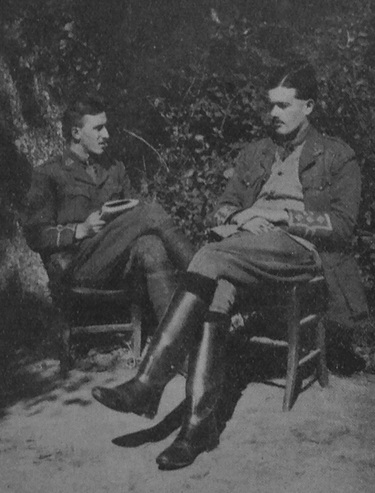
Captain James Vivien Reynell de Castro (above left) was born in Torquay on May 19th 1891. Educated at Beaumont, his father was a serving Major with the 3rd Battalion, York and Lancaster Regiment. At the outbreak of war, he was working as a Sales Executive for the American Motor Company in Turin, but returned as soon as he could to play his part and was gazetted into the 3rd Battalion on 2nd September 1914. He arrived on the western front to join the 2nd Battalion on 28th January 1915 when they were commanded by Colonel Clifford. The 2nd Battalion had at one point been commanded by Colonel Vivian Graham, de Castro's uncle and many quipped that they were "keeping it in the family." On the 20th July, just a few yards from where he was killed, he had held a crater throughout the night, beating off several counterattacks. For his part in the action he was awarded the Military Cross and gazetted Captain. Following the actions of 30th September, he was recommended for a Victoria Cross by the CO; Colonel d'Arch Smith, but he was killed the following day.
Captain Edward Corrigan Smith (above right) was born in Petersfield, Sussex and like de Castro had a serving father in the Buffs. After Sandhurst, he joined the 1st Battalion in Malta. After periods in Cyprus and Egypt, he applied in 1912 for a secondment to the Colonial Office and was accepted serving with the West African Frontier Force in Nigeria and Lohoja. However, after contracting sleeping sickness, he was invalided home after just six months and spent almost 3 years recuperating, he was fit enough to rejoin the Regiment for light duties at the Depot in the autumn of 1914. Desperate to get to the front, he took a posting to the 3rd Battalion, and then after being declared fit, he arrived in Belgium in June to serve with the 2nd Battalion.
Wounded in the same action, Captain C.M.E. Dealtry wrote to Smith's brother "I was wounded in the same attack in which your brother was killed. About 28th September, the Germans blew up, by mens of a mine, a portion of the trenches held bight Regiment on our right, occupying the mine crater and a portion of our trenches. A day or two fat rewards, er were ordered - in conjunction with the bombers of two there regiments - to retake the lost trenches and if possible, the mine crater. We regained a considerable portion of the trenches, but were unable to get the crater. Your brother was hit early in the attack, and killed instantly. his loss is keenly felt by all who knew him, as apart from his being a keen, sound soldier and a brave man, he was exceedingly popular with everyone, and we all feel that we have lost one of the best."
De Castro and Smith were within the Battalion like the biblical characters Saul and Jonathan. Always together and keen to be together in the same actions, they had forged a great friendship in the brief few months they served together. They both met their death at the same time. "They were not divided. They were swifter than eagles, they were stronger than lions."

Forward>>
    Picture
    Welcome to our online 'chronicle' that charted the history of the many battalions of the Suffolk Regiment throughout their service during the Great War.
    This record is now closed, but we have retained all our original posts here for you to search through and in the fullness of time, we hope to add to it as and where new stories come to light.
    It was at times, a challenging but rewarding endeavour which has helped many people in their research of the Regiment.
    If you know the specific month of an action of the Regiment, you can search for it in the list below:


    Archives

    February 2025
    December 2018
    November 2018
    October 2018
    September 2018
    August 2018
    July 2018
    June 2018
    May 2018
    April 2018
    March 2018
    February 2018
    January 2018
    December 2017
    November 2017
    October 2017
    September 2017
    August 2017
    July 2017
    June 2017
    May 2017
    April 2017
    March 2017
    February 2017
    January 2017
    December 2016
    November 2016
    October 2016
    September 2016
    August 2016
    July 2016
    June 2016
    May 2016
    April 2016
    March 2016
    February 2016
    January 2016
    December 2015
    November 2015
    October 2015
    September 2015
    August 2015
    July 2015
    June 2015
    May 2015
    April 2015
    March 2015
    February 2015
    January 2015
    December 2014
    November 2014
    October 2014
    September 2014
    August 2014
    July 2014
    June 2014
    May 2014
    April 2014
    March 2014

Powered by Create your own unique website with customizable templates.
  • Introduction
  • History
    • Our Regimental 'Family'
  • Publications
  • Archives
    • Operation 'Legacy'
    • Friends News Archives
    • Battlefield Tours
  • Join Us
  • Friends News
  • Contact