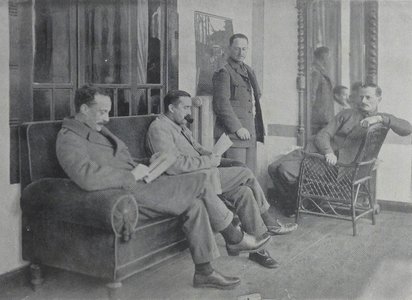
In March 1917, the officers of the Suffolk Regiment who were held captive in Friedberg PoW camp met to discuss the parcels situation for their men. Captain W.M. Campbell and Lieutenant-Colonel W.B. Wallace, who had only recently recovered from pneumonia, held a meeting to decide on the best distribution of the mens parcels. In the preceding months, it had become clear that the food was gradually getting less and less from their captors, and that the men were forced more and more, to rely on the parcels they received from home to supplement their meagre rations. There was however confusion. Men received parcels via the Red Cross from loved ones at home, but also from Regimental Committees in Britain. There seemed however to be no co-ordination between the two organisations. Some times men received as many as five parcels a month. Some men however, received just one. Campbell wrote; "The parcels are excellent, but there are a certain number of men who get their parcels through their regimental committees, and these parcels are not so good nor well executed and it would be much better if these men had their parcels through the central committee." It was clear that the German war effort was beginning to falter. Through the wire of the camp, and the upper stories of their barrack block, Campbell could see the world outside. He noted that "Leather and most articles which can be used for military purposes, have been called in. Motor cars ate forbidden. A few taxis only being allowed in the larger towns. Only a few horses are in use. Draft horses are issued in teams to each town. Every man, woman and child, and all material of military or food value is under direct military control." Food was not also the only gripe of Captain Campbell. The payment of officers wages through the Army Bank of Cox & Co. was perhaps a little bit too frequent for it as being used for gambling and the procurement of much wine by some. "Colonel Wallace is of the same opinion as myself" wrote Campbell "that too much money is being sent to the British and that it is being wasted in some cases on wine and gambling. A few rich men have as much as 20l. a month. Colonel Wallace and two or three others, spoke emphatically against drinking and giving dinners etc. but there are no means of enforcing discipline in these camps." However Friedberg was being abandoned as a PoW camp and the men were being moved to other locations by train. Campbell and Wallace were to part company, but under rather unusual circumstances. Comments are closed.
|
Welcome to our online 'chronicle' that charted the history of the many battalions of the Suffolk Regiment throughout their service during the Great War.
This record is now closed, but we have retained all our original posts here for you to search through and in the fullness of time, we hope to add to it as and where new stories come to light. It was at times, a challenging but rewarding endeavour which has helped many people in their research of the Regiment. If you know the specific month of an action of the Regiment, you can search for it in the list below: Archives
February 2025
|