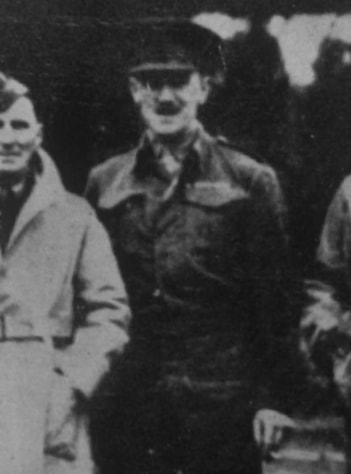
After the village of Zonnebeke had been taken, the enemy launched several counterattacks. All of these were driven back successfully, but on the night of the 27th September 1917, Australian troops on the Battalion's right started to dig in in the open, despite Brigade orders which forbade them to. Such actions immediately brought and enemy barrage down, normally followed by a gas attack. Captain L.J. Baker recalled later how he was caught in that barrage and of when a runner arrived at his shell hole with urgent message: "Inevitably we had casualties. The most unfortunate thing was that I accidentally wounded one of my own men. It was the same night, and it was bright moonlight and jerry had started to shelling gas. We had our gas masks on and were squatting in this shell-hole when a runner chap came along with a message, and he was standing up there silhouetted against the moonlight. I shouted ‘Come down!’- but, of course, he couldn’t hear me because of the gas mask, so I pulled him by the leg. Unfortunately, as he fell down into the shell hole, a bayonet leaning against the side went right through his thigh. It started to gush blood and I was absolutely horrified. I said, ‘I say I'm frightfully sorry about that!’ Well, this chap was grinning all over his face and he said, ‘Oh, that’s quite all right, sir – it’s a Blighty one, isn’t it?’ He was as pleased as Punch. Of course, I had to give him a note to the MO. I scribbled it on a piece of paper and said, ‘This is not a self-inflicted wound. I did it". Born in the picturesque Suffolk village of Lavenham, Louis Baker was to remain with the Regiment. In 1939, as an officer of the 1st Battalion (above), he proceeded to France to join the second reincarnation of the British Expeditionary Force and was evacuated, through Dunkirk. In late 1941, he was to be transferred to the 5th Battalion and was subsequently captured at Singapore, spending three and a half years as a Japanese PoW. an active member of the 2nd Battalion Officers Dinner club, he along with Cannon William Lummis and Major 'Huppy' Hupfield organised their annual reunion dinners well into the 1960s. Comments are closed.
|
Welcome to our online 'chronicle' that charted the history of the many battalions of the Suffolk Regiment throughout their service during the Great War.
This record is now closed, but we have retained all our original posts here for you to search through and in the fullness of time, we hope to add to it as and where new stories come to light. It was at times, a challenging but rewarding endeavour which has helped many people in their research of the Regiment. If you know the specific month of an action of the Regiment, you can search for it in the list below: Archives
February 2025
|