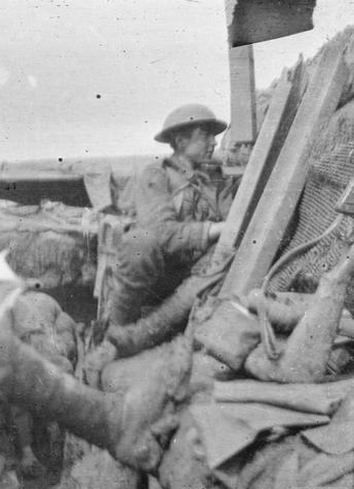
For the Suffolk Regiment's participation in the attacks on the first day of the Battle of the Somme, only the 11th (Service) Battalion (Cambs Suffolk), were involved. At 5.00am on the 1st July, the Battalion moved up from Becourt Wood into their allotted ‘jumping off’ positions in “Dundee Avenue” and “Monikie Street.” The trench names of Scottish origin, date from a Highland Division's time in the sector earlier in the year. At the junction of “Dundee Avenue” and “Arbroath Street” Battalion HQ was established. From here via periscope, the Battalion Commander had an unrestricted view of “Sausage Valley;” the ground over which they were to attack later that morning. On the other side of the Albert-Bapaume road was the aptly named “Mash Valley.” To front right of his positions ran “Lochnagar Avenue” and it was here that morning that a giant mine was to be exploded. Once in the front line positions, the men got prepared for the attack. Each man checked and rechecked the equipment he was carrying that day. Each rifleman was to carry 2 Mills bombs, either a pick or a shovel; with two sandbags tied around it. An additional 60 rounds of ammunition in each pouch (the 11th Battalion were wearing leather equipment) was also issued for the attack and an additional 100 rounds in 2 bandoliers and two gas helmets were to be carried. One helmet with its goggles (PHG) was to be carried in its haversack, the other to be pinned open on the chest; ready to be slipped over the head for instant use. All officers were ordered to carry a rifle and not a stick, and to make them as inconspicuous as possible. “Badges of rank must remain, but all must wear putties.” Casualties were estimated to be high in the opening phase and should any of the precious and highly important Lewis gunners fall in action, qualified men who could operate the guns had to wear yellow braid on their cuffs as identification. The orders issued in the hours before, were quite specific. Men must push on and avoid getting drawn into supporting floundering waves on their flanks. The hunting of souvenirs was forbidden and most importantly, men were not to stop to assist wounded comrades. They must leave them for the Battalion stretcher bearers and move forward. In the front line trenches before zero hour, it was a timed of mixed emotions. One young Cambridgeshire, keen to avoid the battle, shot himself through the knee. Private W.J. Senescall recalled; "He had pluck, I think. It was a strange sight seeing him being carried away on a stretcher under arrest, with a man at each side of him with fixed bayonets. I often wonder what happened to him." Just before zero hour, the issue rum ration came around. Some men drank it down quick and it made them slightly ‘tiddly’ as one private recalled; "Two of them lay on the floor completely out. A Sergeant Major was kicking them both as they lay there to bring them round, although to no purpose." Around 6.30am, a slight drizzle began. Though the men all had full waterbottles as per the Battalion orders, but were forbidden to drink from them. “We got our dixies out and let the rain run into them from our tin hats" wrote one of them, "the rain didn't last long but we caught enough to quench our thirst." At 7.28am two minutes before zero hour, a gigantic mine was blown in front of the Battalion. At the end of Lochnagar Avenue around 65ft underground, 60,000 lbs of ammonal went up causing a crater around 300ft wide and around 70ft deep. As the dust settled, at 7.30am, the whistles blew and the Battalion moved forward into no mans land. The 10th Battalion, Lincolnshire Regiment; the “Grismby Chums, ” moved first and took casualities almost immediately. It soon became apparent that the massive mine had done nothing to silence the enemy, and through the smoke and chalk dust, the sparks of German machine guns in their front lines could be seen still fully operational and inflicting dreadful casualties. In the wake of the "Chums" the Cambs pressed forward. To the left of the Battalion frontage was ‘C’ Company under the command of Major P.F. Morton. To the right was ‘B’ Company, under the command of Captain J.W. Wooton. In the centre was ‘D’ Company, under captain C.L. Morgan. ‘A’ Company were the Carrying Company in the rear, under the command of Captain O.H.Brown. The plans were ambitious that first day. ‘C’ Company were to advance over the German first and second lines and moving through Bailiff wood and push out to the village of Contalmaison behind. Their objective was a redoubt named ‘Suffolk Redoubt’ and they were if needed, to call upon ‘D’ and ‘B’ Company’s for assistance in capturing it. Once taken, the remaining Company’s were to fan out and consolidate. ‘A’ Company were then to be brought up to take a further position named ’Cambridge Redoubt.’ The men could see the carnage that unfolded before them. Soon it would be their turn to advance, but the guns were still active, the line still looked intact and their predecessors had not reached their objective. Could they succeed where others had failed? Comments are closed.
|
Welcome to our online 'chronicle' that charted the history of the many battalions of the Suffolk Regiment throughout their service during the Great War.
This record is now closed, but we have retained all our original posts here for you to search through and in the fullness of time, we hope to add to it as and where new stories come to light. It was at times, a challenging but rewarding endeavour which has helped many people in their research of the Regiment. If you know the specific month of an action of the Regiment, you can search for it in the list below: Archives
February 2025
|