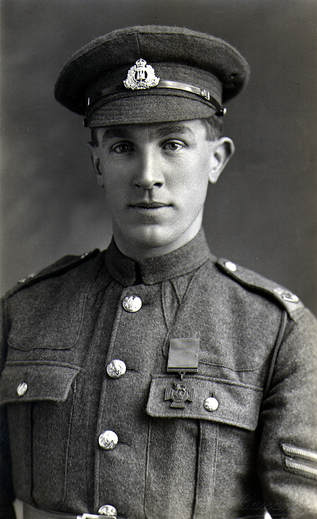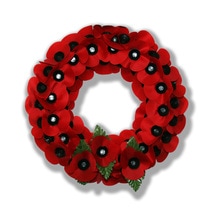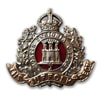
The award of the Victoria Cross to Lance Corporal S.J. Day, was the second that the Regiment has earned during the Great War. Born in Norwich in 1891, Sidney James Day was an active member of the Church Lads Brigade and was an apprenticed butcher when War was declared. He enlisted for service in September 1914 and joined the Suffolk Regiment being posted to the 9th Battalion at Shoreham. He was no stranger to the heat of battle. In September 1915 at the Battle of Loos, he was the only man of his section to come out of the battle uninjured. During the firefight toward the Hulluch Road, Day went out under heavy fire to rescue his officer, Lieutenant Stevens. As a token of esteem for the rescue of their wounded son, Mr and Mrs Stevens presented Day with an inscribed silver cigarette case. Day was wounded during the Battle of the Somme receiving four separate gunshot wounds on the same day; three to his legs and one to the upper body. The latter, was nearly fatal - entering from the side and embedded itself close to his heart, but by some miracle, it was stopped by his paybook and a quantity of field service postcards that were stuffed in his upper pocket. Within weeks, he was back at the front, being transferred to the 11th Battalion. The award of his Victoria Cross for his actions at Malakhoff Farm was formally announced in October 1917 and on the 9th January 1918, he was presented with the award by The King at Buckingham Palace. however, no sooner had he returned to the front, than he was taken prisoner in the German March Offensive, ending the war in captivity. The citation for his award concluded by saying that "he afterwards completed the clearing of the trench and, establishing himself in an advanced position, remained for sixty-six hours at his post, which came under intense hostile shell and rifle grenade fire. Throughout the whole operations his conduct was an inspiration to all." Post-War, Day took a job for the Electric Light Company in Norwich, before moving to Portsmouth in the late 1920s. Here, he opened his own hostelry aptly named "The Sidney Day VC Tea Rooms". He married a local girl in 1939 and the tea rooms flourished until they were tragically bombed in 1941. Day died of tuberculosis in 1959. At his funeral, 2/Lieutenant I.W. Jefferson, representing the Suffolk Regiment, laid a wreath of 150 red and yellow roses. In the twilight of the Suffolk Regiment just prior to its amalgamation, it was touching that the last officer to be commissioned into it, was paying respects to it's last Victoria Cross winner. Comments are closed.
|
Welcome to our online 'chronicle' that charted the history of the many battalions of the Suffolk Regiment throughout their service during the Great War.
This record is now closed, but we have retained all our original posts here for you to search through and in the fullness of time, we hope to add to it as and where new stories come to light. It was at times, a challenging but rewarding endeavour which has helped many people in their research of the Regiment. If you know the specific month of an action of the Regiment, you can search for it in the list below: Archives
February 2025
|